Cooking Eggs in Cast Iron: Your Questions Answered
The questions we hear most often aren't about recipes—they're about what goes wrong, and why. Here's everything you need to know about cooking eggs in cast iron, answered directly.
The questions we hear most often aren't about recipes—they're about what goes wrong, and why. Here's everything you need to know about cooking eggs in cast iron, answered directly.
The Basics
Techniques
Choosing & Caring for Your Pan
Yes. A well-seasoned cast iron skillet can cook eggs just as well as any nonstick pan—without the coatings, chemicals, or short shelf life. The two conditions that matter: your pan needs to have built up some seasoning, and you need to use low heat once the eggs hit the surface. Get those right, and eggs will slide cleanly every time.
Lower than you think. Preheat your pan over medium or medium-low for at least 5 minutes—this ensures even heat across the whole surface. Then, the moment your fat is in, drop it to low. Cast iron retains heat, so your pan will stay hot enough to cook the eggs without any additional heat input. Trying to rush eggs with higher heat is the fastest way to end up with rubbery whites and a stuck pan.
A note on stove type
Gas: Heat is radiant and slightly uneven, so the 5-minute preheat is especially important. Medium-low on gas can run hotter than you expect—when in doubt, go lower.
Induction: Induction is precise and responds quickly, which is both an asset and a trap. Cast iron can develop a hot spot at the center if you rush the preheat. Give it a full 5 minutes at a lower setting than you think you need before adding fat. Once the pan is evenly heated, induction's responsiveness works in your favor: drop the heat and it drops immediately.
Yes. Even a well-seasoned pan benefits from fat when cooking eggs. The good news is that both work, and the choice is mostly personal preference—though each has its strengths.
Butter is the more forgiving option for eggs. It spreads evenly, adds flavor, and gives you a built-in temperature cue: it should foam gently when it hits the pan. If it browns immediately or spits, your heat is too high. For soft scrambled eggs in particular, butter isn't just preferred, it contributes to the creamy, custard-like texture that makes the technique work.
Oil—avocado, olive, or ghee—has a higher smoke point and is a neutral, reliable choice if you prefer it or don't have butter on hand. It won't give you the same visual feedback, so you'll need to rely on your heat settings a little more carefully.
Whichever you choose, add it after preheating, let it heat for a few seconds, then drop to low before the eggs go in. And don't be shy with the amount—a well-lubricated pan is the difference between eggs that release cleanly and eggs that don't.

Almost always one of three things: the pan hasn't been preheated long enough, the heat is too high once the eggs go in, or there isn't enough fat in the pan. And if your pan is newer, don't shy away from eggs—cooked low and slow with plenty of fat, they're actually one of the best ways to build seasoning.
If your seasoning is solid but eggs still stick, the culprit is usually heat. Preheat on medium-low, add your fat, then drop to low before the eggs go in—and then just let them sit. Cast iron holds heat so well that the residual warmth does the cooking for you. This is the Maillard reaction at work: the chemical reaction responsible for browning and flavor develops steadily at lower temperatures, and when you give it time, the egg naturally releases from the pan once it's ready. If it's sticking, it's not done yet.
Fried eggs are where cast iron really earns its reputation; the preheat is non-negotiable. Give your skillet at least 5 minutes over medium heat before anything goes in. Cast iron heats unevenly at first, and a cold spot is what causes whites to stick and spread thin. By the time you add oil or butter, the entire surface should be uniformly hot.
Add your fat, let it heat for a few seconds, then drop to low before the eggs go in. Crack the eggs in and let them cook undisturbed until the whites are just set, about 2 minutes. This is the Maillard reaction at work, the browning and flavor development you want happens at moderate temperatures, not high ones.
Then flip. Using our Slotted Turner—move slowly and let the spatula do the work rather than forcing it. If your pan is well-seasoned and your heat was right, the egg will release cleanly. If it resists, give it another 20–30 seconds. Feeling confident? A well-seasoned pan with sloped walls makes the classic one-handed wrist flip more achievable than you'd think — see our guide to flipping eggs in the No.5 cast iron.
After the flip, cook times are short:
Over easy — 30 seconds. Yolk fully liquid, whites just set on top.
Over medium — 1 minute. Yolk beginning to set at the edges, still jammy in the center. Over hard — 2 minutes. Yolk cooked through completely.
Sunny Side-up? Crack the eggs in, pour about two tablespoons of water around them, and cover with a lid. The steam cooks from above while the cast iron works from below—no flipping required. Leave covered and undisturbed for 1½ minutes. Lid off, straight to the plate. Season with salt and pepper after, not before.
→ See our recipe for Fried Eggs with Skillet-Bloomed Spices

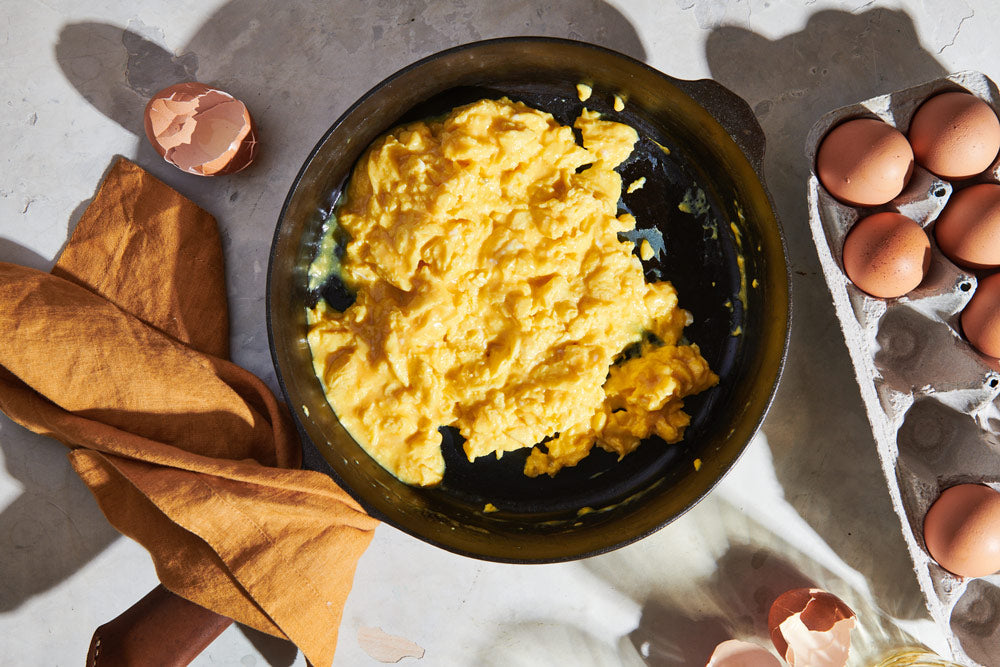
Standard scrambled eggs in cast iron come down to two things: a proper preheat and restraint on the heat. Warm your skillet over medium-low for about 5 minutes, cast iron needs time to heat evenly, and rushing this is where most people go wrong. While it warms, whisk your eggs until the yolks and whites are fully combined, then season with salt and pepper.
Add oil or butter to the pan, let it heat for a few seconds, then drop to low before the eggs go in. From here, resist the urge to stir constantly. Use a silicone or wooden spatula to fold the curds from the edges toward the center, letting them build up rather than breaking them apart. Pull the pan off heat while the eggs still look slightly underdone—the residual heat will finish them in about 30 seconds. They'll be softer than anything made at higher heat.
The omelet has a reputation for being a chef's proving ground—the dish culinary schools use to separate the careful from the careless. We're less interested in perfection and more interested in a hot, customizable meal that tastes exactly how you want it.
Preheat your skillet over medium for at least 5 minutes before anything goes in, this is the step most people skip and the reason most omelets stick or cook unevenly. Add butter, let it melt and swirl it to coat the surface, then pour in your whisked eggs.
From here, move quickly. Stir with a spatula while gently shaking the pan, breaking up large curds to create an even layer that sets at roughly the same time. Once you have a soft, uniform disk of eggs—about a minute, add your toppings over one half. Cheese goes on first so it has time to melt; everything else on top of that.
The omelet is ready to fold when the top looks creamy but there's no remaining liquid egg. Slide your spatula around the perimeter to loosen it, then fold one half over the other. Tip the pan toward your plate and use the spatula to guide it down.
A note on mix-ins: whatever you're adding should already be cooked. The eggs can gently melt cheese, but they can't cook a raw vegetable or finish a piece of meat. Prep your fillings first and the rest comes together in under two minutes.

Yes—and with the right pan, it's easier than it looks. The classic one-handed pan flip works by tilting the pan slightly toward you and flicking your wrist forward and upward in one quick, confident motion. The egg travels up the curved wall, rotates in the air, and lands back in the pan. The key word is confident—a hesitant flip is what sends eggs sideways.
A standard cast iron skillet can technically do this, but the weight makes it tiring. A lighter pan with sloped walls changes the equation entirely, which is exactly why we built the No.5 Chef Skillet. At 2.2 lbs with flared sides, the flip goes from a feat to a flick.
→ See our guide to cooking in the No.5 Chef Skillet
Smaller than most people reach for. A 7–8 inch pan keeps the whites contained so they pool together into a clean circle rather than spreading thin across a large surface. It heats faster, responds to temperature changes more quickly, and is light enough to maneuver one-handed.
We built two skillets with eggs in mind, and the right one depends on how you cook. The No.5 Chef Skillet is 7.5 inches with flared, sloped walls—ideal for omelets, fried eggs and the wrist flip, where the curved sides help guide the egg up and over.
The No.6 Skillet is a more traditional straight-sided skillet—the same compact size but better suited to sunny side up and scrambled eggs, where you want the whites contained and the pan stable. Both work beautifully for eggs. It comes down to technique preference.
A well-seasoned cast iron pan outperforms nonstick in almost every way that matters long-term: it builds a better surface over time rather than degrading, it has no coatings to flake or off-gas, it goes from stovetop to oven, and it lasts indefinitely. The tradeoff is that it requires more care upfront and doesn't forgive high heat the way a fresh nonstick pan does.
The reason most people reach for nonstick is that cast iron feels harder—but that's usually a seasoning or technique problem, not a material one. The No.5 Chef Skillet was built to close that gap: cast iron performance at a weight that finally makes it practical for everyday egg cooking. Read about why we made it →
For a deeper look at the pan itself, see our complete Chef Skillet guide.
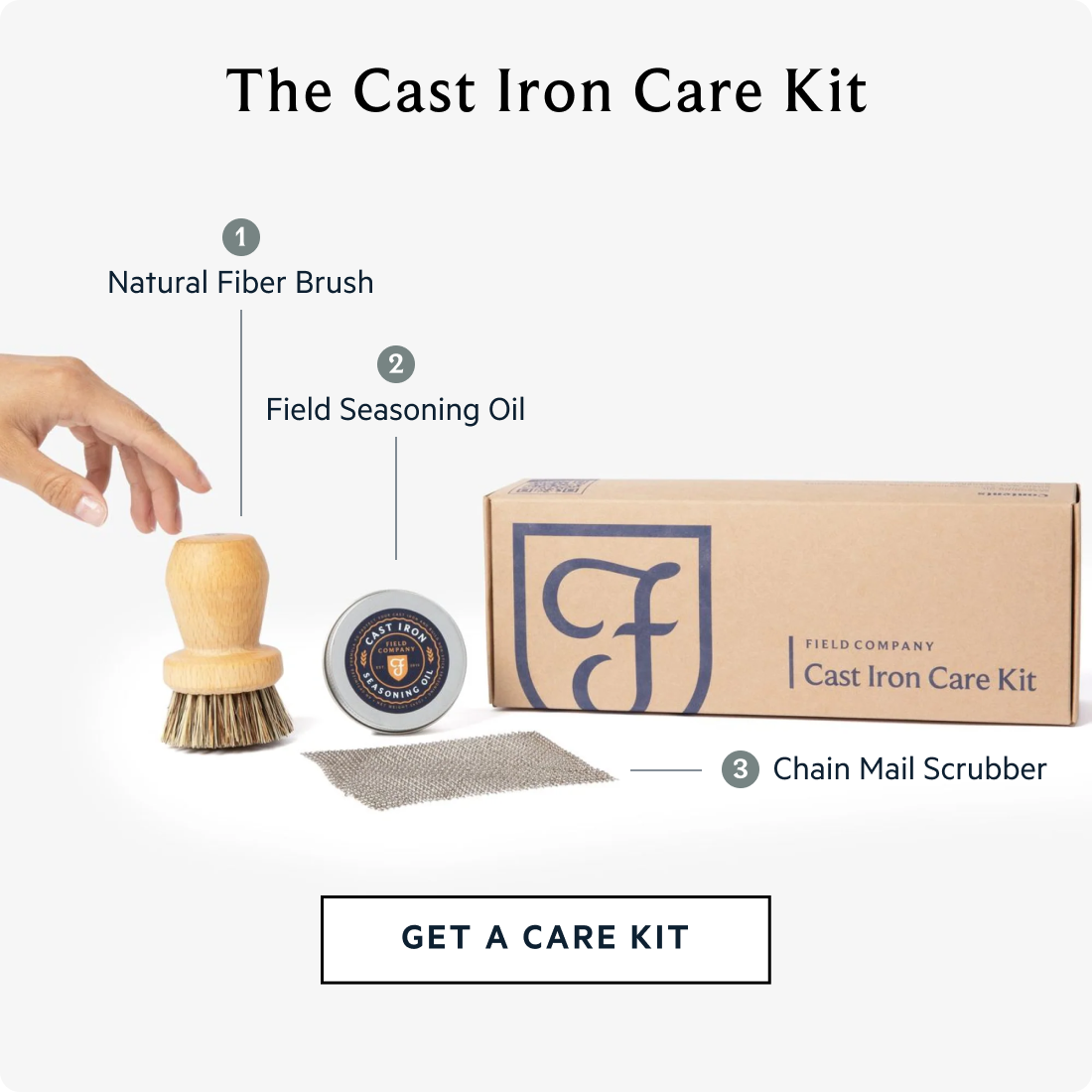
No—and if your pan is well-seasoned, cooking eggs regularly will actually improve it. The fat you use to cook with contributes to seasoning over time. The one thing that can strip seasoning is acidic food (tomatoes, citrus, vinegar) left in the pan for extended periods. Eggs are neutral and pose no risk. Clean your pan with hot water and a brush, dry it thoroughly, and you're good.
If you notice a thin film of egg residue after cooking, it usually means the heat was slightly too high. Lower it next time—that's the only adjustment needed.
Looking for recipes? See our full guide to cooking eggs in cast iron. Ready to try a pan built for eggs? Learn more about the No.5 Chef Skillet.